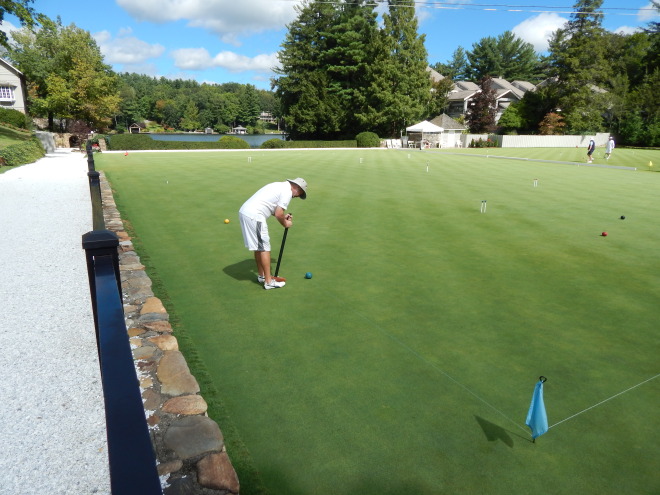
 Ben Rothman at Lake ToxawayLAKE TOXAWAY, NC -- I spent last weekend in western North Carolina and witnessed the end of the Toxaway Mountain Challenge Invitational and the start of the USCA GC National Championships. In between, I took part in a USCA strategy session centered around marketing and communications and also witnessed a doubles exhibition match held in the rain at the Lake Toxaway Croquet Club between Sherif Abdelwahab/Ben Rothman and Rich Lamm/Stephen Mulliner. Abdelwahab and Rothman won that match and you can view some video here.
I saw four different clubs during the weekend and took in a lot of info. Here's what I came away with in no particular order:
The western area of North Carolina (referred to as the Plateau) has now grown to 1,300 croquet members. The majority of those player are not USCA members as the entire state of North Carolina currently has a total of 274 members. Think about what that means considering the USCA has a total of 3,000 members and roughly 1,000 players that participated in sanctioned events in 2012.
What is the key to growth in the area? Both George Enochs of the Lake Toxaway Croquet Club and Michael Albert of the Cedar Creek Raquet Club said the same thing. They started with golf croquet and treated it as a legitimate form of croquet rather than an introduction. We hear a lot in USCA circles that club managers and presidents are utilizing GC to try to promote growth. What I learned to ask myself in North Carolina is -- am I really treating GC as an equal? The truth is I generally treat the game as an intro even though I may be touting it as the version that can be played at a very elite level as well purely social. I've held very few "competitive" GC tournaments or competitions. Despite the fact that new players always are quickly drawn into the game. Most often, I've tried to bring those players into one of the bonus shot versions of croquet once they show an interest -- likely too soon in most cases. And I don't play near enough legitimate GC myself, even though it would be the best thing for my overall game.
Still, a big factor in the success in North Carolina is that they are getting clubs to build courts. After all, GC is not really going to get converts when it is played on long grass. How are they getting clubs to buy in? For one, it takes someone on the board to be a true champion. Once that happens and a plan for a court gets under way, that champion has to be active in promoting, recruiting and teaching. Once that starts though, look out ...
There is definitely a snowball effect going on in North Carolina. Once a couple of clubs got going, it put pressure on the neighboring clubs to add a court. And that explains the billboard featuring croquet I saw on the highway.
But what are the clubs getting out of this burst of croquet enthusiasm? Overall, there is an increase in revenue related to retention, food and beverages, merchandise, tournaments and other activities. When you have 70 people show up for a regular Monday night session, that is clearly going to have an impact on the restaurant and bar.
What seemed to really stick out though as the true benefit is the inherent advantage croquet has over golf or tennis in the social aspect. If the croquet courts are near the clubhouse, when the mallets are in session that creates a center of activity around the clubhouse that drives enthusiasm and engagement. The nature of golf croquet (especially doubles) is that players can be talking in their own game in the game nearby or to people off the court. Golf is actually relatively isolated in that a foursome heads out on a great big course then returns in four hours. They certainly are social upon the return, but the event of golf is spread out enough that it is really a challenge to "watch" a club level tournament.
Tennis generally is closer to the club, and offers a bit more energy and player density, but it is still spread out. This is not to say croquet is better than tennis or golf, the idea is simply that it provides an additional buzz around the club that appeals to basic human nature. That kind of energy is hard for a club manager to pass up once they see it in action.
The overall societal benefit of croquet shouldn't be under-estimated either. I'm not sure there would be anything rougher than that moment when you finally have to admit that your body can't handle tennis or golf anymore. Croquet has often played the role of replacement sport in that scenario. That's great news for club managers from a member retention perspective. More importantly though, our sport may be a key to healthy, active, engaged and happy lives for our exploding 60 to 100 population.

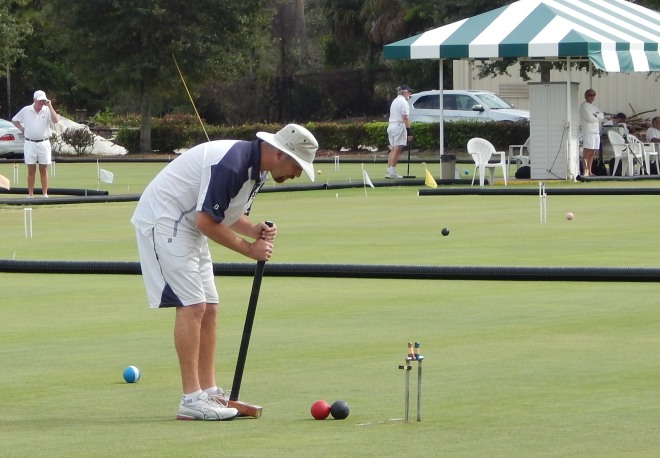 Ben Rothman in play at the 2013 Eights