
At the top of this week's news is the Norwegian Nine-Wicket Croquet video (see link below). There is so much that the video touches on, but the main discussion was centered toward the concept that it is really roque that is being played. It is of course interesting to see how the game has evolved in different parts of the world. No matter what the Norwegians think they are playing, I would agree with the assertion that it is pretty much roque. Fundamentally though, it hardly matters. Take away the short mallet restriction and one-hand rule (seemingly unique for Norway) and it's pretty much nine-wicket croquet.
Read MoreNorwegian Nine-Wicket Croquet Video
Announcement: Woodranch Croquet Invitational
WoodRanch Croquet is pleased to announce their second tournament of the year, a 9 Wicket Singles scheduled for Sunday, October 9, Simi Valley, California. The event will
Read MoreWoodRanch Croquet Holds Last Man Standing Tournament
After a rained out February date, the new WoodRanch Croquet Club held its first 9 wicket croquet tournament on Sunday, May 22 at the Rancho Simi Community Park in Simi Valley, California. The WoodRanch Croquet Club is a group of people of all ages that enjoy the Simi Valley Parks and love to play croquet. Two players competing for the Rose Cup were Eric and Caren Sawyer.
Read MoreMallethead: Questions for Croquet
1. Where Is Our Golf Croquet World Team Championship?
Start with four regions -- North America, British Isles, Africa and Oceania. Four tests -- Canada vs U.S., U.K. vs Ireland, Egypt vs South Africa, Australia vs New Zealand. The following year winners advance to final four hosted by a predetermined region winner.
Read MoreStart with four regions -- North America, British Isles, Africa and Oceania. Four tests -- Canada vs U.S., U.K. vs Ireland, Egypt vs South Africa, Australia vs New Zealand. The following year winners advance to final four hosted by a predetermined region winner.
Croquet Poll: What Kind Of Croquet Do You Play?
Morning Coffee: USCA Student Discount, WCF Webmaster and Arkansas Nine-Wicket
News, news and more news. Most U.S. players are chomping at the bit, hoping for some warm weather to get out there and hit the courts. In the meantime, the world of croquet on the internet is generating all kinds of info ...
Read MoreNine to Six: Part 4 - Wiring
A Clear-Cut Difference
Wiring is pretty simple -- six-wicket has it and nine-wicket does not. Of course, if you haven't played six-wicket, you likely have no familiarity with the wiring rule. For the full details, you can check out this page on the USCA website, but the essence is that when utilizing the opponent's balls, you must leave your opponent a shot when your turn ends.
Nine to Six: Part 3 - Boundary Play
After a month off due to a very busy website schedule in November, it was time to get the Nine to Six series back on track. This month, we are looking at the boundary rules for nine-wicket and the U.S. six-wicket games. At the USCA nine-wicket national championship, option two and three of the advanced rules are utilized which effectively means that boundary rules mimic the U.S. six-wicket rules with just one subtle exception. In the nine-wicket game, a ball is considered out of bounds once it touches the line as opposed to six wicket where a ball would not be ruled out of bounds until half of the ball crosses the line.
Read MoreBilly Bob Breeden Interview Excerpts
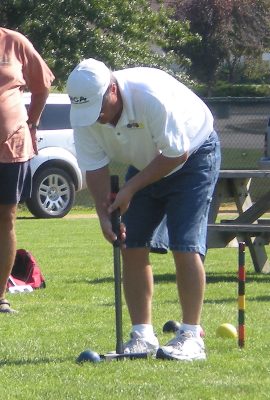 Breeden during the 9W doubles championshipThis is a follow up to yesterday's post on George Cochran. During interviews for the November issue of the magazine, I had interesting conversations (via e-mail) with both Billy Bob Breeden and George Cochran on nine-wicket that I wasn't able to fit into the magazine story. Today I'm posting the discussion I had with Billy Bob. Here's a link to the conversation with George.
Dylan: Let's start with your general impression of nine-wicket play compared to six-wicket croquet, now that you have two of these national nine-wicket tourneys under your belt.
Billy Bob: One of the things that I find harder about 9W versus 6W is the long grass. It is hard to control your breaks, but it can be done. Now on the flip side, sometimes it is hard to control your balls around the wickets on short grass whether it is 9W or 6W. Just a little hit and it may give you a tough shot on a tight wicket. I know from playing at the 9W nationals two years in a row that both years the field conditions were great for the tournament. We had a lot of break play and some of them were long breaks.
Dylan: Do you see nine-wicket as maybe being able to provide organized croquet in areas where courts are not available? In other words, is a nine-wicket club possible?
Billy Bob: Yes I do, right now there are several organized croquet club in Missouri. Just in my area, I can think of a few -- the Stanberry, Mo croquet club, they have a sand court, in the middle of their town that was built in 1973, and it is in the local park. The Chillicothe Croquet Club just plays in the local Chillicothe Park every third Sunday during the summer, I think they told me two years ago, they had been playing for 43 years, so they have had organized croquet for 45 years. The Trenton college also has a local tournament held on their campus every year. In Albany, Missouri, the local community club is trying to organize and build a court in their park. Years ago almost every little town in American had some kind of croquet being played in their local parks. Our biggest challenge is how to get our young people out of the house and onto the croquet course. I think that we all should contact organizations like local Boy Scout, Church groups, athletic directors and 4H groups and start organizing youths at an early age. Maybe even offer class in the local parks free to teach croquet.
Dylan: Wow, I had no idea there was that much croquet activity anywhere close by. Are any of those players in that region participating in the national tournament?
Billy Bob: I have tried for at least four years to get them to my tournaments. The only success was an older man from Chillicothe after I had played with them a couple of times on their sand court. He showed up for two years, but I think his age (88) was making it hard for him to hit the balls in long grass. He likes to play roquet -- an American variant of croquet played on a hard, smooth surface. There are about twelve players in Stanberry, Missouri I’ve been working on for two years, but I think the name “Nationals” scare them off. They already play both two-ball singles and doubles.