
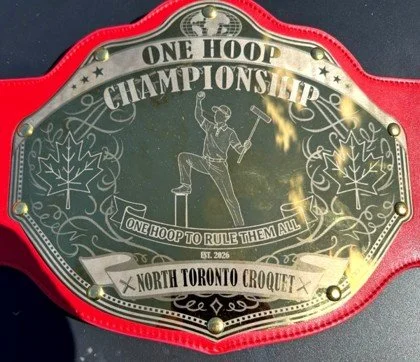
Every match is a deciding hoop. Lose and you're out … maybe. A fun and social format that works for any number of players and at all skill levels.
Picture yourself at hoop 13, game 5, World Championship. Win one hoop and you’re the champion. Now picture doing it a handful of times in one evening to become the One Hoop Champion. The rules are simple. The strategy is up to you.
How a match is played
The match. Every match starts at the deciding hoop. One hoop, winner advances.
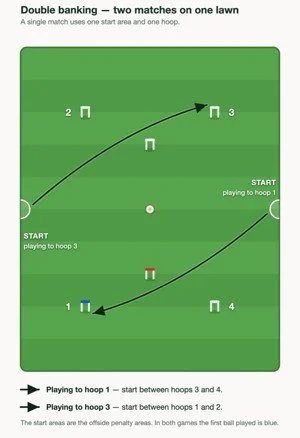
The start. Play begins from the offside penalty area — between hoops 3 and 4 if you’re playing to hoop 1, and between hoops 1 and 2 if you’re playing to hoop 3 (double banking).
The toss. Toss a coin. The winner chooses to go first or second. The first ball played is blue.
The swap. After the blue ball is played, the second player may choose to swap and take blue as their own.
If they swap, player 1 plays red from the starting position.
If they don’t, player 2 plays red from the starting position.
The other two balls. Black and yellow are played as normal: if you own blue, you also play black; if you own red, you also play yellow.
Balls — and sides — can only be swapped after the very first shot.
This start was promoted by Reg Bamford for golf croquet because it reduces the value of winning the toss, which can otherwise have a large influence on who wins a single hoop. We played from the offside position to limit wear on the starting corner the night before our championship.
The most interesting shot in croquet
That swap rule turns the first stroke of every match into something croquet doesn’t otherwise ask of you. You are, in effect, cutting the cake for someone else to choose from. Put blue somewhere genuinely good and your opponent simply takes it off you — and now you’re the one playing catch-up from the start area. Put it somewhere safe and useless and they’ll happily leave it with you.
The only stable answer is a ball placed so that you’d be content either way.
Which is exactly the point. It drains the advantage out of the toss, because the player going first is motivated to make the two options equal.
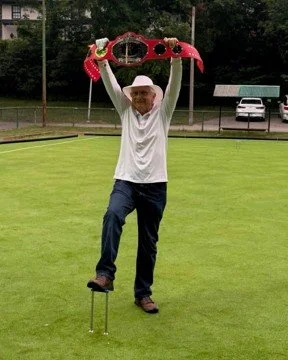
THE BELT: Our One Hoop Championship has a perpetual trophy: a custom wrestling belt.Bill Simmons Jr., the first One Hoop Champion. North Toronto Croquet Club, July 2026. The pose is not an accident — the figure on the belt stands the same way, one foot up on the hoop.
Do you even want to go first? The toss winner chooses. Going second means you never have to solve the cutting problem — you just choose. Going first means you decide what the two choices are.
Where do you play blue? Short of the hoop? Past it? Wide?
It is interesting to see the varied thoughts and executions. I have seen multiple attempts to play three yards wide of the hoop come up short, leaving the opponent the easy swap decision.
The night
The first One Hoop Championship was held in July 2026 at the North Toronto Croquet Club, as a social event the night before the Canadian National GC Championship. We put music on and ran a pizza party alongside it.
A One Hoop event is a spectator event whether you plan it that way or not. Matches are short, so nobody is stuck on a lawn for an hour while the party happens without them. Players who go out have nothing to do but watch — and a crowd that has just been knocked out is the best crowd there is.
Everyone loves watching a game come down to the last hoop. Here, every game does.
Anyone can beat anyone in a one hoop match – that is a feature. You can accommodate nearly any number of players from all different skill levels in one seamless and fun event.
Running one
The format is supported end to end in the Croquet Tools Tournament Manager. You set it up, run the draws from your phone, and the bracket plays out on a screen in the clubhouse.
The draw is part of the show
The first-round draw is released one pairing at a time, at your pace. Each pairing lands with the two names flying in from opposite edges of the screen. The manager may choose to seed protect any number of seeds, or just make completely random matchups.
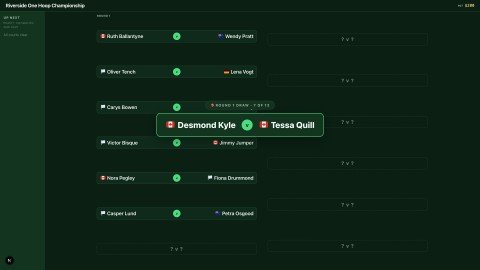
Seven of thirteen pairings released. The rest are still a mystery to the room.
Reveal them a tap at a time, or set it rolling every few seconds and let it play itself out while you pour drinks.
Optional rebuys — a guaranteed second game
After the first round, anyone who lost can buy back in. The re-entrants are redrawn at random against the first-round winners, never against the player who just beat them, and the whole rest of the bracket is wired at that moment — every path to the final is on the board from then on.
If the numbers don’t divide evenly any spare winners take byes, and a player who had a bye in round one always plays here, so nobody gets two byes in a row.
Rebuys are a great way to build a winner’s prize pool – or give every player who lost in the first round one free rebuy, so that everyone is guaranteed two matches.
Keeping the lawns moving
Double-bank the early rounds and run them rolling: as each match finishes, the next pair on the board walks straight onto the space it just vacated. Nobody waits for a full round to complete. From the quarter finals we dropped to one match at a time, and picked the lawn and hoop closest to the clubhouse for maximum audience engagement.
Optional golden tickets — win a spot
When the number of players you have is going to create byes, you may opt to sell golden tickets. The premise is simple. If you are going to have 3 byes and you have 12 players who were eliminated, you are simply asking those 12 who wants to play again. Presuming more than three want to play, you randomize the selection.
We did this through selling tickets to the draw. $20 to try and buy back in. The manager ticks the players who paid to try and rebuy. When ready, the tool randomizes and displays the winners. You don’t need to sell the tickets — you may simply choose to randomize them. We sold them with all sales going back to the players: 50% added to the winner’s share and 50% to a lucky loser draw.
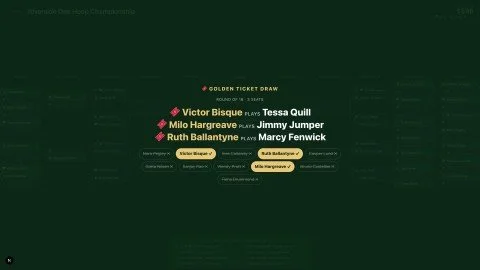
Three seats, eleven hopefuls. Winners go gold, the rest are struck through — and can enter again next time seats come up.
The bracket
The whole event renders on a clubhouse TV as a converging bracket: the first and rebuy rounds down the outside, the championship rounds folding in to the final in the centre. Golden-ticket players carry a ticket badge the rest of the way.
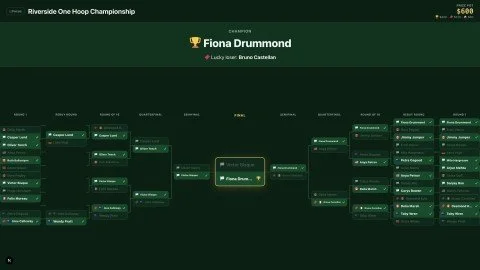
A finished event. The board is display-only and updates itself; you run the night from your phone, marking winners as players come off the lawn.
Optional money factor
We offered $250 cash to the winner of the event. The purpose was to take a silly competition and make it mean something. The finalists were essentially playing one hoop for $250.
In addition to offering a prize pool, the One Hoop tool allows you to sell rebuys and golden tickets. You set the entry price and how the money should be split. Choose a percentage to the winner, a lucky loser or the event, and the tool handles the rest. Players see the stakes right on the board.
We split the ticket sales to provide a lucky loser payout. Everyone who played but did not win was entered to win the loser cash prize, and players received an extra ticket to the lucky loser draw when rebuying.
Every draw that touches money — the golden lottery, the lucky losers, the pairings themselves — uses a cryptographic random source.
Run one at your club
One Hoop is a native event type in the Croquet Tools Tournament Manager. Create the event, add your players, and the draws, the board, the buy-backs and the prize pot are all handled.
Get started today at croquettools.com.
The One Hoop Championship format was devised by Adam Barr with input from KS Tsang. The tool to run and manage the event was built by Adam Barr for CroquetTools.com. Display screens shown are from a demonstration event; the players in them are fictional.